Agrammon
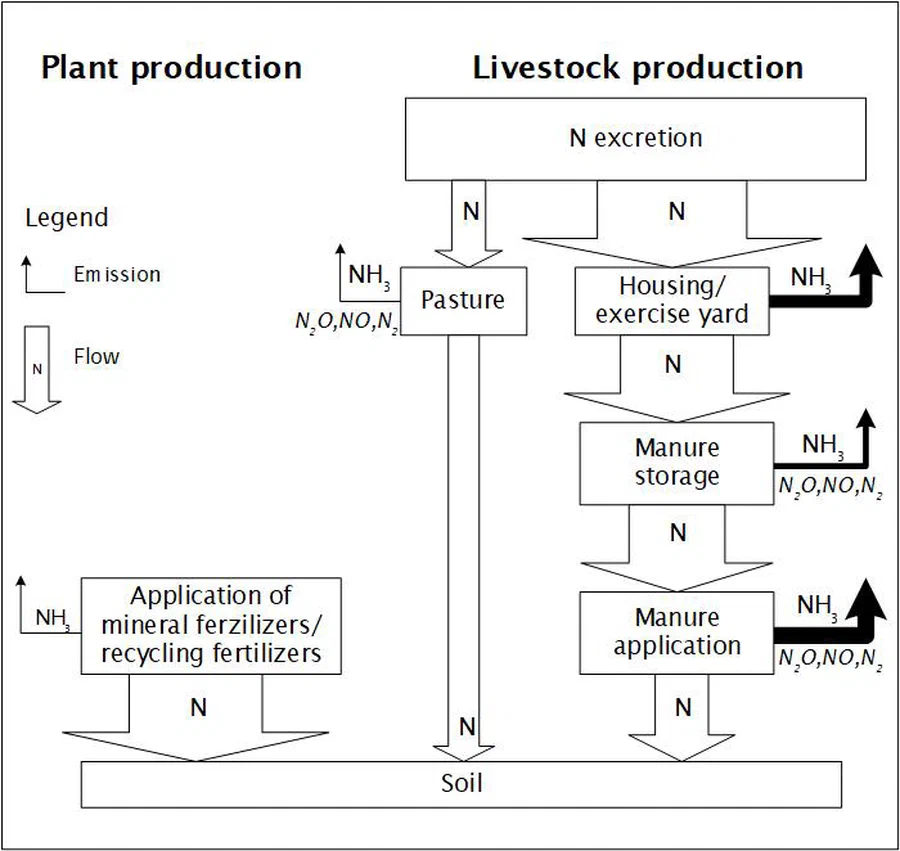
Ammonia volatilisation is a significant source of nitrogen (N) loss in Swiss agriculture. More than 30,000 tonnes of nitrogen are lost this way every year. This represents almost one-third of the N load of farmyard manure, and results in both a financial loss as well as diminished productivity for the farmer. At the same time, ammonia emissions are detrimental to the environment, in particular to natural ecosystems.
The simulation model Agrammon allows ammonia emissions to be calculated, and shows how changes in structure and production methods at the farm level affect emissions.
The model was developed by the School of Agricultural, Forest and Food Sciences (HAFL) and the companies Bonjour Engineering GmbH and Oetiker+Partner AG, with support from the Federal Office for the Environment (FOEN).
Agrammon Model
model.agrammon.chSingle Farm Model
The Agrammon Single Farm Model is based on model parameters and processes which are well supported by scientific knowledge. It allows the input of the relevant parameters with a direct link to the individual farm. Only parameters are required which are easily available to the farmer.
Open model →Regional Model
The Agrammon Regional Model is suitable for the simulation of regional agricultural ammonia emissions. It is based on the Single Farm Model, but allows the input of regional animal numbers and the percentages of production techniques used in the region. The simulations use the same algorithm as the Single Farm Model.
Open model →Cantonal Adaptations
⚠ This variant is frozen and will be taken offline in 2028.The Single Farm Model with Cantonal Adaptions is intended for cantonal purposes, for example the evaluation of building applications. It is based on the standard version and contains additional emission-reduction measures as well as a function to submit datasets to the relevant cantonal office.
Open model →